
The pound made a leap over an abyss
Long-term review
The rise of the British pound after the Bank of England meeting resembles a dead cat's jump - a popular Forex formation when a currency bounces on its last breath and then goes to the bottom like a stone. Investors were confident that Andrew Bailey and his colleagues from the Monetary Policy Committee would either expand QE by £200 billion or send a clear signal that they would do so at the next meeting in June. In fact, only 2 out of 9 MPC members voted to double the amount of asset purchases - £100 billion. Even the BoE chief's attempt to sweeten the pill didn't help. According to him, the central bank can increase the scale of QE, it keeps all options for monetary expansion open.
The slowness of the British regulator is understandable. He was faced with a double uncertainty, and in such a situation, the best way is to sit on the side of the road. First, in the week to May 17, the next round of negotiations between Brussels and London started, and if the parties do not move, the way out of the impasse may be delayed, and eventually turn into a divorce without signing documents, a return to the WTO rules and duties. Secondly, everyone is interested in the question: how deep has the economy fallen into the abyss because of the pandemic? The Bank of England forecasts that Albion's GDP will decline by 3% in the first quarter and by 25% in the second quarter. As a result, the indicator will fall by 30% in January-June, which will be the deepest decline since 1709. Then the economy was affected by severe frosts.
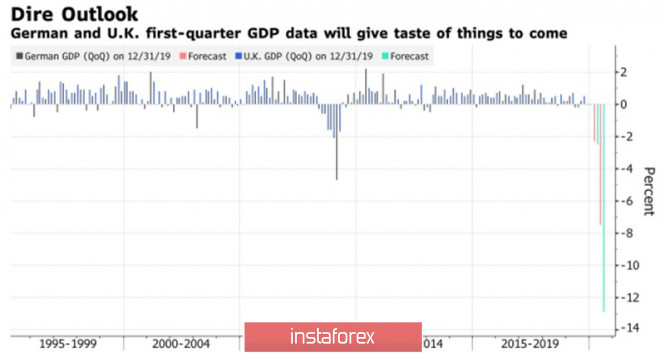
The week to May 17 may partially clarify the question of the depth of the recession because it will be published data on British GDP for the first quarter. According to Bloomberg experts, the indicator will decline by 2.5%, which will be the most serious shock to the economy since 1974. By comparison, German gross domestic product is expected to decline by 2.3%.
GDP dynamics in Britain and Germany
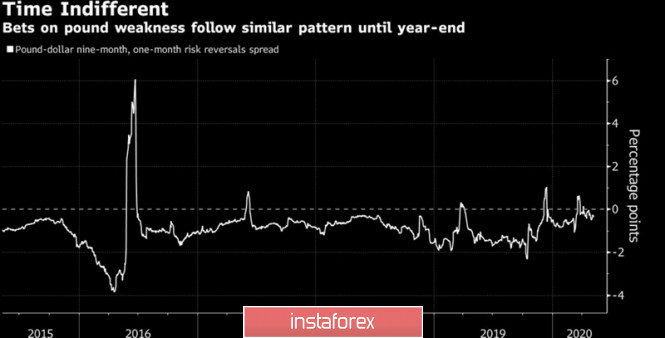
Against the backdrop of terrible macro statistics, the passivity of the Bank of England and unresolved problems with Brexit, the stability of the pound looks amazing. According to Rabobank, the market clearly underestimates the likelihood of a divorce between Britain and the EU without a contract. The risks of a reversal of the pound, taking into account the difference in premiums for call and put options, are significantly lower than in February 2019, when a disorderly Brexit was at stake. And the negotiators don't have much time left. Brussels says the Treaty must be concluded in October so that lawmakers can ratify it.
Dynamics of risks of the British pound reversal
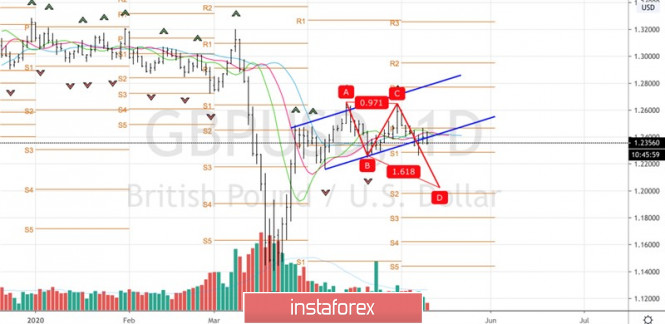
Support for the "bulls" for GBP/USD was provided by the growth of US stock indices in response to the terrible statistics on the US labor market for April and the expectations of CME derivatives that the federal funds rate will fall below zero by June 2021. Both events are negative for the dollar. Nevertheless, gradual profit-taking on US stocks and the understanding that the Fed will not go for negative borrowing costs will return investors' attention to the pound. This allows you to sell GBP/USD on the breakout of supports at 1.235 and 1.229, where important pivot levels are located, in the direction of targets at 127.2% and 161.8% on the AB=CD pattern.
GBP/USD, the daily chart
*The market analysis posted here is meant to increase your awareness, but not to give instructions to make a trade.

Performed by Marek Petkovich,
Analytical expert
InstaForex Group © 2007-2020
Benefit from analysts’ recommendations right now
Top up trading account
Get a bonus from InstaForex
InstaForex analytical reviews will make you fully aware of market trends! Being an InstaForex client, you are provided with a large number of free services for efficient trading.

Read More


No comments